

Can A Bent Silverplate Bowl Be Repaired
Reports of the demise of this Web site are greatly exaggerated! Nosotros at sheldonbrown.com thank Harris Cyclery for its back up over the years. Harris Cyclery has airtight, just nosotros keep going. Keep visiting the site for new and updated articles, and news about possible new affilations.

If yous are interested in advertising on this site please go to SheldonBrown Ads.
If You are Stuck...
This commodity describes some means to repair a steel forepart fork or frame well enough to get you rolling again, without access to professional tools.
A warning: Many of the techniques described here are for emergency repairs just, and should not exist considered as permanent or completely safety fixes. These techniques crave skill, and are not always successful. Attempts at repair can cause further damage. You apply the techniques described here at your own risk.
But on the other manus, if you're stuck 100 miles, or 1000 miles, from a bike shop, the advantage may well outweigh the risk.
Steel is Real
Steel is by far the preferred frame cloth for cyclists who tour into remote areas.
A steel frame unremarkably bends first, giving a warning, rather than unexpectedly breaking autonomously.
A steel frame can be straightened (within limits) if bent, and still remain safe and strong. A welder anywhere in the globe tin perform a repair -- perhaps ugly, only condom -- on a steel frame which is damaged so information technology can't simply be straightened.
A steel frame can remain serviceable with dings, dents and scratches which return a carbon fiber frame unsafe to ride. Aluminum, titanium and carbon-fiber frames are much more than difficult to repair, if they can exist repaired at all.
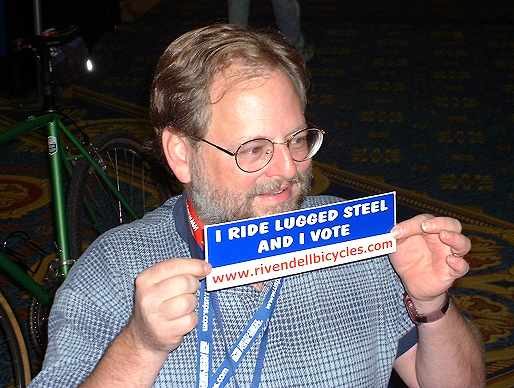
My friend John Schubert takes a stand.
But the weight...
Sure, a steel frame may weigh a kilogram or and so (a couple of pounds) more than a fancy carbon-fiber, aluminum-alloy or titanium frame. A bicycle designed to exist durable and repairable might besides accept other components which are heavier -- but the difference has a minimal effect on travel time. The bicycle itself makes up only well-nigh twenty% or less of the weight which the rider must propel up hills. The other 80% or more is the passenger, -- maybe as well luggage. Except when a bike is heavily loaded with baggage, the added weight volition but slow a climb by only a few percent, if that. The difference is much less on level ground, where nearly ability goes to fight aerodynamic elevate. On downhills, a heavier wheel is faster!
If you ride where a cell telephone call will summon your spouse, a friend or a taxi, then feel gratis to savor the advantages of a lighter bicycle. It will have a different "feel" because of the lighter weight and because it transmits route roughness differently. (Information technology could either feel rougher, similar many fat-tube aluminum frames, or smoother, like most carbon cobweb frames.) If you race, by all means, a lighter bicycle could get you across the end line a few seconds earlier, and win the race. I am not ashamed to say that I accept a Cannondale road racing cycle for recreational riding.
Simply, if you ride far from home, and especially if you ride in places where replacing a bicycle frame would exist fourth dimension-consuming, difficult or expensive, go with steel. Information technology is the pick of Cycle Friday, Rivendell, Waterford and other companies which brand high-grade touring bicycles.
As well run into Sheldon'due south article on frame materials.
At present, onward to specific repairs.
Professional tools
An understanding of how professional frame-alignment tools work can help yous figure out how to perform a good alignment, or something close, with improvised tools. The image beneath, from an old Var tools catalog, shows a professional frame alignment tabular array and fork alignment jig. Notation: these tools are not for sale at Harris Cyclery, and some of them may no longer be manufactured by Var.
In the image below, note that:
- Alignment of all parts of the frame is with reference to the lesser subclass.
- Alignment of the fork blades is with reference to the fork crown and the steerer tube, which is assumed to be straight (though information technology may non exist, following a crash -- we'll address that). The steerer tube is clamped so it can't bend when the blades are being aligned.

Front end-end damage
The following comments apply to a wheel with a steel frame and a rigid, steel front fork with blades that taper downwards from meridian to bottom; not a suspension fork. A moderately bent steel fork or frame tin can usually be straightened. A crumpled or cracked fork or frame can sometimes be made rideable with a welded or brazed reinforcement. The all-time repair, except in the case of slight, simple bends, is replacement -- merely in example you tin't...
Fork aptitude back?
A bicycle fork is not designed to withstand an affect from the front. A relatively light touch on caput-on into an obstacle -- a car, a fence -- which pushes confronting the front of the tire can bend a steel fork astern. The wheel takes the impact the aforementioned as the normal weight load, and often will be completely undamaged.
The fork blades will usually bend dorsum below the fork crown, and the steerer tube will bend inside the head tube of the frame-- a hidden bend, but you tin encounter that the lower headset races are no longer parallel. The headset bearings will probably exist loose, or demark, depending on the angle at which yous plough the fork.
If the fork is bent back, the bicycle's steering will be heavy, there may be toe clip overlap, and in farthermost cases, the front bicycle may interfere with the down tube. If the curve is that extreme, an emergency repair may not be the best idea...
Forepart terminate of frame aptitude back?
A elementary way to correct a rearward curve in a steel fork is to turn the fork around backward and slam the bicycle into a wall once again -- but that may merely further impairment the frame, which may already take damage, just behind the head tube, making the head tube angle steeper. (An aluminum or carbon-fiber frame volition more than likely either be undamaged or break.)
There used to be a bike-shop tool which works similar an automotive bumper jack. One terminate rests against the bicycle'southward bottom bracket and the other has a dummy axle to insert into the front fork's dropout slots, or a pipe which inserts into the caput tube. You could improvise a tool like this with a borrowed automotive jack. You could straighten the fork and frame at the same fourth dimension, though it is unlikely that everything will return precisely to its original position. Besides, headset race seats may take go distorted, and so the races are loose (run into communication below), and begetting balls may have indented the races, causing "indexed" steering. All the same, may be able to get the bicycle rideable again this mode.
You could insert a piping into the head tube, clench it to something sturdy, and haul up on the rear of the frame past manus.
Moderate oestrus with a torch helps straighten ripples on the underside of the down tube and top tube, though you will damage the pigment and -- unless you remove the pigment beginning, make a sooty stench. Don't use plenty heat to melt brazing. If the tubes are crumpled, y'all may demand to braze or weld steel plates to reinforce the joints between the head tube and the other tubes, once alignment has been restored.
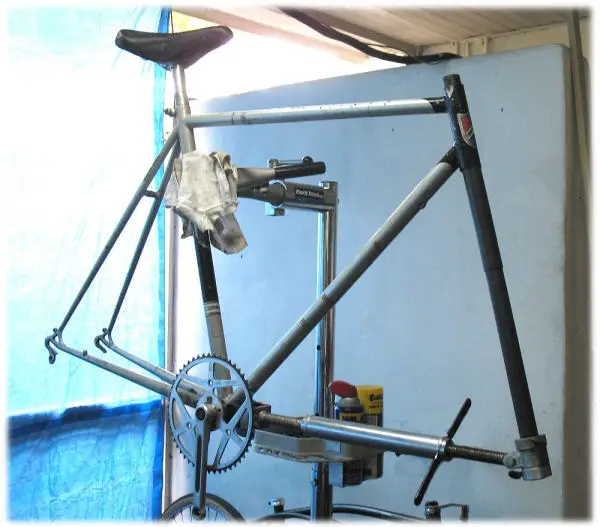
Park frame straightener (no longer sold). It is shown straightening only the
frame, without the fork. Cheers to Kurt Kaminer for the photograph.
Steerer tube alignment
If the steerer tube is aptitude, the headset bearings cannot be correctly adjusted. A more sophisticated fork repair is possible in a mutual metalworking shop, by removing the fork from the frame to straighten the steerer tube first, then the fork blades. First, remove the fork crown bearing race. Yous could clamp the fork crown between blocks of woods in the jaws of a bench vise, and use a heavy steel pipe which simply fits over the steerer tube to straighten it until it is at a right angle to the shoulder of the crown race seat. One side of a carpenter's or machinist'south square rests confronting the crown race seat, and the steerer tube is checked for parallelism with the other side. A metal ruler also may exist used, with its end resting against the crown race seat. Lacking these tools, you just effort to get the steerer as straight equally you can.
The bend in the steerer tube will be partway upwardly, only higher up the lower section which has thicker walls or an internal reinforcing sleeve. Slide the tube down every bit far as you tin can, so that its lower stop rests on the reinforced lower terminate of the steerer tube and it straightens the bend rather than creating another bend.
The goal here is to get the headset bearing races parallel, so the headset begetting doesn't become looser or tighter every bit you turn the fork.
Check the steerer carefully for cracks. These volition be nearly axiomatic while yous are applying strength to bend the steerer.
Rebending the fork blades
Later on straightening the steerer tube, I rebent the fork blades with blows of a rubber mallet, checking that they were parallel and symmetrical effectually the extension of the steerer tube. Measurement is the most exacting part of this job. Bicycle framebuilders use a special gauge to marshal a fork, as shown in the image from the Var catalog, above. A pic of a bootleg fork alignment jig is here . Alignment too tin can be checked by placing a wheel in the fork. The rim should sit equidistant from the fork blades, just nether the fork crown. Plough the wheel around and endeavor information technology both means to check that information technology is centered, or take an average if information technology is not.
Also check that the dropouts are correctly aligned. A rough test of this may be made with the front hub. A hub with loving cup-and-cone bearings can still be functional with a aptitude axle and misaligned bearings. If the axle and dropouts have matching misalignment, but both announced intact otherwise, you could ride to the next bike shop at some pocket-size chance. Checking for dropout alignment is described in another file on this site.
Likewise see Jobst Brandt's comments on bent forepart forks. He describes a way to marshal fork blades which are bent to the side, without whatsoever tools other than your ain easily and feet!
Fork bent forwards
If the front wheel has landed heavily on a horizontal surface, the forepart fork may exist bent forrard. This is an extremely dangerous bend. With ane hand on the handlebar, the steering will tend to weave because the feedback from the handlebar is abnormal. If both easily are removed, the front wheel will suddenly turn to the side, throwing you forward over the handlebars.
Ordinarily, the frame will be undamaged. Because the intersection of lines extended from the down tube and head tube is more or less directly over the hub axle, a vertical impact does not produce big bending stresses on these tubes!
Fork aptitude to the side
A fork also can be bent to the side, or one fork bract tin exist aptitude dorsum more than than the other and so the bicycle is tilted. If y'all ride through water, the wheel tracks of your bicycle should course a single line. If ane tire track is off to the side of the other, the fork (and/or the frame, see below) is out of alignment. And so you take to lean to ane side to continue the bicycle upright, if you tin can ride at all without easily on the handlebars. The tire may rub on a restriction shoe or fork blade. And if the fork is aptitude to the side, the frame likewise may be twisted...


Aligning a Frame
If a bicycle pulls to the side, the front and rear of the frame -- non simply the fork -- should be checked. The bicycle will not rails properly unless all of these parts are in alignment.
If the front triangle -- and front fork -- of a bike frame are aligned correctly, the front bike will track in line with the passenger.
Correct alignment of the rear triangle is besides necessary to place the rider'southward weight straight over the wheels. If the rear triangle is aligned correctly, then the chainline at the cranks and at the rear hub volition also agree, and the the chainwheel(s) and rear sprocket(s) will be parallel.
If all of the parts of the frame are in alignment, and the wheels are centered, it will be possible to ride the wheel no-easily. That is the msot stringent test of a cycle'south alignment.
The front-triangle misalignment problems described below are in the order in which they need to be corrected, but the problems closer to the bottom of the list are more common. So, you may exist able to do a quick check and skip several steps.
Frame tube visibly bent in the middle merely non crumpled?
For the seat tube, downwards tube of peak tube, you could drill out a wooden block to the same diameter every bit the tube, and saw information technology in half. Place one half against the side of the tube and tap it with a hammer, increasing force until the tube is straightened. Sheldon describes this technique in his article about his Raleigh International bicycle.
Here's another epitome from the Var itemize showing a tool to realign seatstays. This tool applies the opposing force to the seatstay either side of the bend, reducing the tendency to alter dropout alignment. I've succeeded with a length of bending iron, wooden blocks to avoid scratching the paint, and C clamps. The dropout alignment should be checked anyway -- come across below.

Seat tube out of line?
Equally described above, all parts of a bicycle frame should exist aligned with reference to the lesser bracket vanquish.
Alignment starts with the seat tube. Information technology is unusual for the seat tube to be bent, simply if information technology is, it must be realigned first. To check, you could place a straightedge against the face of a chainwheel running upward next to the seat tube. The straightedge should be equidistant from the top and bottom of the seat tube. Rotate the chainwheel 180 degrees, cheque again and take the boilerplate in case the chainwheel is canted. You could also identify the straightedge forth the side of the seat tube to check for a curve.
For the meridian end of the seat tube to be hauled to one or the other side, the bottom-bracket trounce has to be clamped securely. Framebuilders do this work on an alignment table as shown in a higher place, only I accept succeeded by clamping the faces of the bottom subclass crush firmly between wooden blocks in a big bench vise, inserting a piping into the seat tube and pulling the pipage to the side.
Once you lot accept removed the crankset to clamp the lesser-bracket shell, you lot can't use the chainwheel for measurement whatsoever more. But on the other hand, y'all will rarely find that the seat tube is bent.
Down tube aligned to lesser bracket vanquish?
The aforementioned procedure applies hither every bit with the seat tube.
Front triangle twisted?
The front triangle of the frame may twisted so the head tube tilts slightly with relation to the seat tube.
Defective a frame alignment table, you lot could stand in front of the cycle and sight along the edge of the caput tube to meet whether it is parallel to the seat tube. Placing a straightedge alongside the head tube makes any twist easier to visualize.
Realignment is with a piping inserted into the head tube, while holding the bottom bracket clamped. The peak tube will tend to move more considering its bore is smaller. If you pull on the pipage above the top tube, you will tend to motility the top tube sideways more; if y'all pull on the pipe below the down tube, the downwards tube more,. If y'all have already aligned the downward tube, you want to make your adjustment at the top tube. The sideways adjustment to make the needed adjustment in the bending of the head tube is pocket-size, because the caput tube is curt, but y'all might want to go dorsum and check the down tube and seat tube, simply to be sure.
Rear end lf the frame bent sideways?
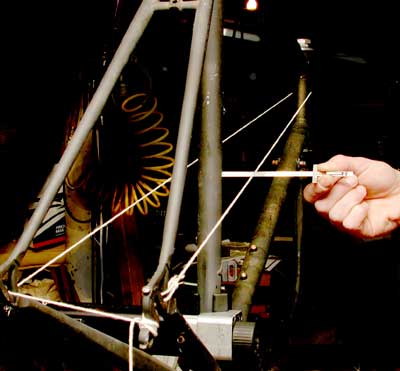
Testing and correcting alignment of the rear end of the frame is accomplished as described in the commodity on this site near frame spacing.
The you practise this with a length of string, a ruler (or even only a stick where you tin can marker lengths) and a wooden plank.
Testing rear-triangle alignment with a string
Crumpled, stripped, cleaved...
Onward...
Headset bearing seats distorted?
Moderate distortion of bearing seats so they no longer concur the begetting races in a printing fit is easily fixed with "plastic steel" -- epoxy glue with embedded steel particles. Pocket-sized looseness can be addressed with blueish threadlock compound. Either of these materials can be cleaved autonomously later by a blow to the bearing race, and scraped off, so a new race tin be installed.
Before the cloth hardens, the headset should be adapted, the bicycle ridden and the headset readjusted, so as to seat the races.
This is non necessarily only an emergency repair. I accept performed it in the course of routine rebuilding.
It is sometimes possible with professional cycle shop tools to manufacturing plant the begetting seats to have a different begetting race printing-fit size.
Fork threads stripped?
Replace the fork, or if y'all tin can't::
- Cut down the fork steerer and splice in a replacement from another fork. This may also be unthreaded, for use with a threadless headset and clamp-on handlebar stem. (unlikely, though, that these parts volition be handy for an emergency repair...). Encounter information near splicing, below. The splice needs to exist low enough to allow insertion of the quill-type stem which is used with a threaded headset, but otherwise the higher, the better because stresses are everyman most the top of the steerer tube. This repair is not practical if the steerer tube is short.
- Remove spacers, so you lot can re-engage the threads. Or, cutting down the top of the head tube, but this can merely exist done well with a professional cycle shop tool, and the bike shop probably tin can sell yous a replacement fork.
- Utilize plastic steel to secure the headset locknut, but then don't expect ever to go information technology off unless you lot burn off the plastic steel with a torch.
Bottom-bracket threads stripped?
This problem is near likely to occur when working on the bicycle and is much more probable with an aluminum-alloy frame than a steel one. The classic repair is to rethread the bottom-bracket beat out to the Italian dimensional standard -- ane mm larger in bore than the others -- but this requires professional bike-shop tools and Italian-standard bottom-bracket parts. Some bottom-bracket shells do not accept thick enough walls to let the rethreading. A Velo Orange threadless bottom bracket offers some other solution. If but one side is stripped, you could secure the bottom-subclass cup on that side with plastic steel -- same removal issue as with the headset locknut, only worse.
Dropout bent or cleaved?
If the rear derailer gets caught in the spokes, the right rear dropout may be bent or broken. If it is just bent, it can usually be bent dorsum into shape. Heat from a torch can brand this job easier, simply don't apply enough heat to cook brazed joints. For once, an aluminum frame may offer a simpler repair: the derailer hanger is often a bolt-on part.
If the derailer is pretzeled, the classic repair, is to shorten the chain and ride the bicycle every bit a singlespeed.
Small dents
Don't worry about these. If you can admission the inside of a tube, you could run a length of pipe (for example, a seatpost), into the tube to button out a dent. A professional person framebuilder may use metal blocks, drilled out to the bore of the tube and sawed in half, then clamped over the tube. Because the margins of the dent are raised, clamping the blocks down may button the dent out. Pressurized water inside a tube also could remove a dent, but that gets rather high-tech...
Deeply aptitude, crumpled or broken frame tubes
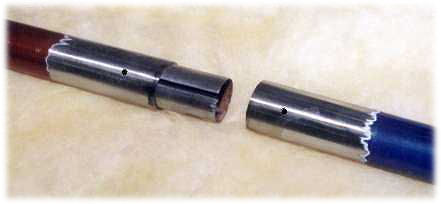
If a frame tube is crumpled, you might straighten it then reinforce it. Brazed or welded steel plates tin can reinforce joints betwixt tubes, once alignment has been restored. A welded or brazed-on reinforcement can splice the ends of a broken or crumpled tube.
The image at the left shows a frame tube prepared for splicing. Paint has been sanded off either side of the articulation. The inside of the tubes to be spliced likewise has been sanded clean. A length of tubing has been cut lengthwise and so it can be compressed and slid into the spliced section as a reinforcement. Small holes have been drilled where brass can exist applied and will flow into the joint.
 If you are far from a welding shop, you might splint a crumpled tube, for example with automotive hose clamps and a length of bending iron. The tube must nevertheless exist able to have a load in tension, and so a splint is reasonable if the tube is crumpled, but not cleaved. The tension and angle stresses on a chainstay, or whatsoever function of the front end fork, practise not let of splinting and clamping, though I once did manage to ride home on my Raleigh Twenty with a right chainstay which had rusted out from the inside and broken. That was on a non-derailer cycle and the chain held the chainstay together.
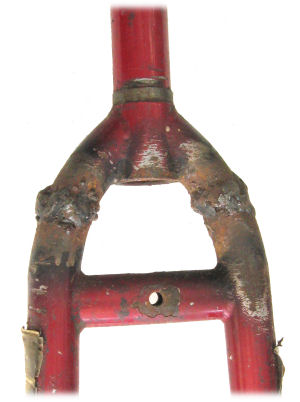
The image at the right shows an ugly but strong weld to the forepart fork of my married woman's recumbent bicycle. If not for this repair, the plans for our bicycle tour would take been completely dashed. Another article tells the unabridged story.
Replacing frame tubes...
A steel frame tin can be repaired by replacing a frame tube outright. This is sometimes done to restore a celebrated or valuable frame, but may likewise be done just to get a frame back on the road. A trashed frame can provide the needed material. I repaired the Raleigh Twenty frame I mentioned before past brazing in the chainstays and chainstay bridge from a trashed frame.
Maintaining correct dimensions is important in this work. With the Xx, I left the seatstays and rear dropouts still in identify, and I clamped a dummy rear axle into the dropouts to hold them in alignment.
- What'southward New
- Sheldon Dark-brown on Facebook
- Site Feedback & Questions
Articles past Sheldon Brownish and Others
- What'southward New
- Beginners
- Cycle Glossary
- Brakes
- Commuting
- Cyclecomputers
- Exercise-Information technology-Yourself
- Essays and Fiction
- Family Cycling
- Stock-still-Gear
- Frames
- Gears and Drivetrains
- Sense of humor
- Old Bikes
- Repair Tips
- Singlespeed
- Tandems
- Touring
- Video
- Wheels
- Translations
- Sheldon - the man
Reports of the demise of this Web site are greatly exaggerated! We at sheldonbrown.com give thanks Harris Cyclery for its support over the years. Harris Cyclery has closed, but nosotros keep going. Proceed visiting the site for new and updated articles, and news about possible new affilations.
Copyright © 2022 John Allen
Harris Cyclery Habitation Page
If you would like to make a link or bookmark to this page, the URL is:
http://sheldonbrown.com/steel-frame-repair.html
Last Updated: by John Allen

Source: https://www.sheldonbrown.com/steel-frame-repair.html
Posted by: coatesquidents96.blogspot.com
0 Response to "Can A Bent Silverplate Bowl Be Repaired"
Post a Comment